The complete Fundamentals of Improvisation course. Learn to create real solos in Soul, Funk, Blues, Pop and Jazz and finally feel freedom on the instrument.
what's in the course
Fundamentals of Improvisation is a complete step-by-step course that helps saxophonists start improvising from scratch and confidently play real solos in different styles.
Even if you’ve never improvised before, this course will guide you through a clear system that quickly develops musical freedom, confidence, and a professional sound.
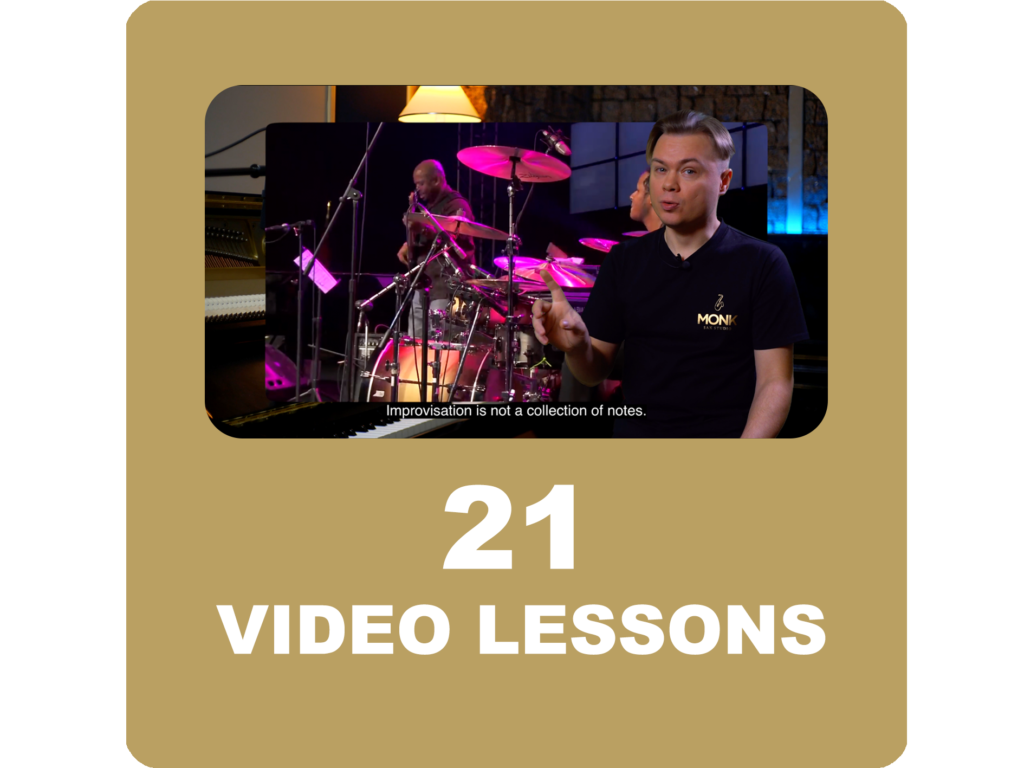
Inside, you’ll find 21 in-depth lessons (2.5 hours of video + high-quality backing tracks). You’ll learn the same fundamental principles top jazz musicians use to make their solos sound natural, rich, and truly musical.
What you'll learn:
Improvise professionally using the minor pentatonic scale
Build real solos step by step (instead of just playing random notes)
Create groove, beautiful phrasing, and master the secret of rhythmic phrasing
Play a classic 12-bar major blues solo
Use powerful techniques: bends and approaches (jazz “enclosures”)
Sound expressive and confident in any style
A unique system bonus
You will also master my original method for building your own improvisation vocabulary:
How to create your personal “Phrase Dictionary”
How to practice phrases in all 12 keys
How to apply them in real music over backing tracks
How to naturally combine phrases into full solos
This course doesn’t just give you scales and theory — it provides a practical system that will transform your playing and make improvisation easy, logical, and inspiring.
If you’re tired of guessing notes and want to finally play real solos with confidence — this course is for you.
Complete Course Package
What’s Waiting for You Inside
Lesson - 1, What is Improvisation?
What is improvisation and why does a musician need it? In this video, we explore its essence - how it helps to express emotions and "speak" through an instrument. From classical to jazz, funk and fusion, improvisation is a powerful tool for self-expression. It's not just about playing notes - it's about conveying feelings and turning music into a true language of the soul.
Lesson - 2, Improvise in Any Key
The Secret Jazz Musicians Use to Improvise in Any Key
In this lesson, you’ll learn how thinking in scale degrees — not note names — unlocks real improvisation.
This approach helps you understand why notes work, create musical clarity, and freely move ideas between keys.
We’ll cover the role of key degrees, tension and resolution, and use the major pentatonic scale as a practical starting point.
Jazz musicians don’t think in notes — they think in movement and function.
Lesson - 3, Main vs Secondary Notes
Most musicians focus on scales, but real musicality comes from rhythm. In this video, I break down the hierarchy of notes inside rhythm — which notes are primary, which are secondary, and how this affects groove, accents, and phrasing. This approach will immediately improve your improvisation and rhythmic awareness.
Lesson - 4, Rhythm - 1st degree
In this lesson, you’ll learn how to use rhythmic patterns on the saxophone over a backing track, focusing on the first degree of the minor pentatonic scale.
The main goal is to clearly bring out the primary note while smoothly connecting it with secondary passing notes — creating a strong sense of phrasing and direction in your lines.
The lesson is fully interactive: I demonstrate each idea, and you play along in real time, repeating and internalizing the patterns as we go.
Lesson - 5, 1st & 7th degree
In this lesson, we expand the same approach by working with two scale degrees of the minor pentatonic — the 1st and the 7th.
You’ll practice rhythmic patterns over a backing track while learning to clearly emphasize the primary note and smoothly connect it with secondary tones across both degrees. This helps develop stronger phrasing, movement, and musical control in your improvisation.
As in the previous lesson, the format is fully interactive: I demonstrate each idea, and you repeat it in real time, playing along and internalizing the patterns step by step.
Lesson - 6, 1st & 3rd degree
In this lesson, we take the next step by applying the same concept to two scale degrees of the minor pentatonic — the 1st and the 3rd.
You’ll work with rhythmic patterns over a backing track, focusing on clearly highlighting the target note while smoothly connecting it with supporting tones. This approach strengthens your phrasing, adds melodic direction, and makes your lines sound more intentional.
Lesson - 7, 1st, 3rd & 7rd degree
In this lesson, we will expand on the previous concept by adding a third supporting note, the 7th degree of the minor pentatonic scale. You will work with three degrees (1, 3, and 7), using the rhythmic patterns from the video lesson, focusing on clearly identifying the target notes and smoothly blending them with supporting sounds. This approach opens up more options for phrasing, adds depth, and makes your improvisation more expressive and conscious.
Lesson - 8, 1st & 4th degree
In this lesson, we'll take it a step further by applying rhythmic patterns to two degrees of the minor pentatonic scale—the 1st and 4th. You'll work with a phonogram, focusing on clearly identifying the target notes and naturally combining them with supporting sounds. This approach helps to diversify phrasing, expands your aural perception, and makes your improvisation more lively and expressive.
Lesson - 9, 1, 3, 4 & 7th degree
In this lesson, we’ll take it a step further by combining the four degrees of the minor pentatonic scale—1, 3, 4, and 7. You’ll work with the rhythmic patterns from the video lesson, focusing on clearly identifying the target notes and blending them smoothly with supporting sounds. This approach greatly expands your phrasing options, adds freedom to line construction, and makes your improvisation more rich and musically convincing.
Lesson - 10, 1-st & 5th degree
In this lesson, you will explore the sound of the 1st and 5th degrees of the minor pentatonic scale through rhythmic patterns. Working with the video lesson, you will learn to naturally emphasize supporting notes and organically weave them into the musical context. This approach creates a sense of stability in phrases, helps to better control the development of the line, and makes improvisation more confident and collected.
Lesson - 11, 1, 3, 4, 5 & 7th degree
In this lesson, you will combine all the degrees of the minor pentatonic scale — 1, 3, 4, 5, and 7 — into a single system. Working with the rhythmic patterns from the video lesson, you will learn to move freely between the supporting notes, creating coherent and logical musical lines. This approach opens up maximum possibilities for improvisation, helps you think more broadly, and makes your sound more mature and confident.
Please note:
This action will also remove this member from your connections and send a report to the site admin.
Please allow a few minutes for this process to complete.